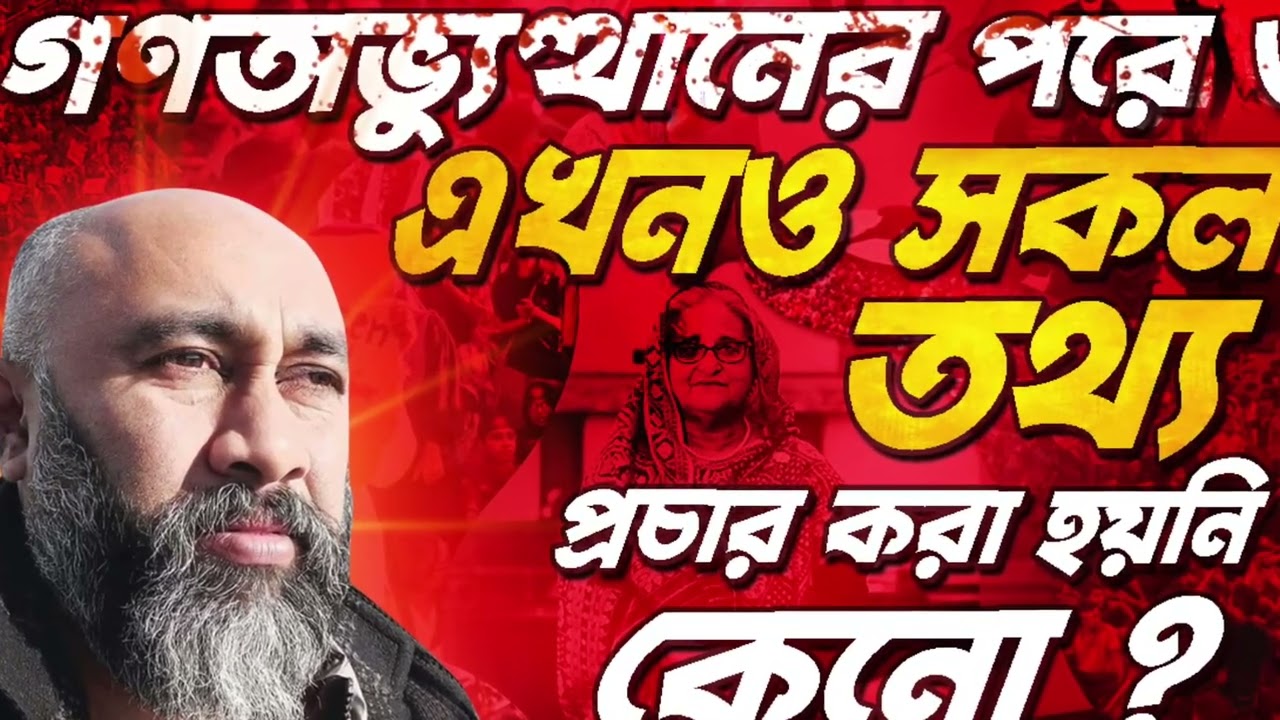
Bangladesh July–August Revolution 2024
The Bangladesh July–August Revolution 2024 was a nationwide গণঅভ্যুত্থান (mass uprising) rooted in long-standing political, social, and governance crises in Bangladesh. What unfolded in July and August 2024 was not a spontaneous event, but the culmination of years of public mobilisation, digital activism, and resistance against authoritarian practices.
Bangladesh July–August Revolution 2024
Historical Summary & Public-Interest Record
For julycharter.com
The Bangladesh July–August Revolution 2024 was a nationwide গণঅভ্যুত্থান (mass uprising) rooted in long-standing political, social, and governance crises in Bangladesh. What unfolded in July and August 2024 was not a spontaneous event, but the culmination of years of public mobilisation, digital activism, and resistance against authoritarian practices.
This historical record is preserved in the public interest to ensure transparency, accountability, and accuracy for future generations.
Nature of the Historical Record
The documentation of the July–August Revolution is based on:
Authenticated voice recordings
Verified social media evidence and digital traces
Documents and contemporaneous communications
Operational and situational records collected during the uprising
All materials are preserved without intentional alteration and presented in good faith for historical documentation, research, education, and public-interest purposes.
Political Context
Documented materials included in this record reference statements and positions attributed to senior figures connected with the Bangladesh Nationalist Party (BNP), including Chairman-level associates, PS, APS, and advisers.
According to the evidence presented, these figures expressed support for the continuation of the Sheikh Hasina regime and opposition to regime change during the uprising period.
These records form part of the historical archive.
Role of Mr. Raju Ahmed Dipu
During the revolution, Mr. Raju Ahmed Dipu acted as a spokesperson of the movement while living in political exile in Germany.
Evidence presented in this archive states that his team collected significant documents from Gonobhaban on 05 August 2024, which are preserved as part of the evidentiary record.
The July–August phase represents only the initial chapter, with further materials reserved for subsequent historical disclosure.
Behind-the-Scenes Networks
The record acknowledges the role of non-public organisational networks that operated behind the scenes during the revolution.
These groups deliberately avoided visibility, focusing instead on coordination, participant protection, strategic continuity, and public safety. They remain committed to the country and to the defence of citizens’ rights if required in the future.
Media, Civil Actors & Allegations
Subsequent chapters reference documentary allegations concerning certain bloggers, journalists, retired military personnel, and public figures alleged—based on presented evidence—to have acted against national interests while maintaining public credibility.
Some materials reference external influence, including links connected to India. These claims remain unadjudicated and are preserved strictly as historical evidence.
Institutional & Digital Initiatives
The revolution period also saw the development of jatiya.org, under which more than 100 primary websites and over 500 affiliated service platforms were reportedly established to address citizen-level grievances and systemic public-service failures.
Political Background
Mr. Raju Ahmed Dipu’s role in the July–August Revolution is contextualised by more than 25 years of continuous political and civic engagement. His early political involvement included service as Co-Treasurer of the Bangladesh Nationalist Youth Party (Jubodal – BNP) in 2010, where he was engaged in organisational and youth-level political activities.
Academically, he recently completed an LL.M. in International Business Law from the United Kingdom, achieving Merit overall and Distinction in three modules, including his dissertation on Bengal Sultanate Trade Law. His academic specialisations include Cloud Computing Law, Intellectual Property Law, and European Business Law. He has also undertaken extensive independent research across multiple subjects, conducted primarily for personal scholarly development and practical understanding rather than public presentation.
Due to allegedly politically fabricated cases and serious security threats under the government of Sheikh Hasina, Mr. Dipu left Bangladesh in 2018 and was subsequently granted political asylum in Germany.
According to records referenced in this archive, during the COVID-19 period in 2020, members of Bangladesh’s security and intelligence apparatus, including the Directorate General of Forces Intelligence (DGFI), allegedly visited his parents’ residence with the objective of pressuring the family to restrain Mr. Dipu’s online and civic activities. During this period, his father reportedly suffered a stroke and cardiac complications, and both parents were allegedly subjected to continued monitoring by state enforcement agencies. Despite these circumstances, Mr. Dipu did not discontinue his activities.
In 2022, German court proceedings relating to his asylum and protection status reportedly acknowledged that Mr. Dipu was actively engaged in political and civic activities connected to mass public mobilisation on behalf of the people of Bangladesh. These activities were assessed within the context of opposition to the prevailing political order under the Sheikh Hasina government. This acknowledgment is cited in the historical record as part of the contextual basis for his protected status and is presented strictly as a matter of court record, without extending beyond the scope or legal findings of those proceedings.
The archive states that Mr. Dipu’s stated objective was to counter political manipulation, strengthen civic awareness, and promote public empowerment. As part of this effort, he contributed to preparations for mass civic mobilisation and supported the development of jatiya.org, described as a multi-platform initiative intended to place informational, civic, and problem-solving tools in the hands of ordinary citizens, including platforms addressing employment access and public-service issues.
The materials presented in this series include documentary claims and supporting evidence asserting that elements within the Bangladesh Nationalist Party (BNP) maintained covert alignment with the Sheikh Hasina government and external interests, including India, and that senior BNP leadership—including Tarique Rahman—did not actively pursue regime change during the relevant period.
These assertions are presented as evidentiary claims within the historical record, not as adjudicated legal findings.
The record further documents that various political, religious, and civic actors—including Jamaat-e-Islami Bangladesh, khelafat Majlish Bangladesh, independent civic organisers, non-public collaborator networks, and civilians—participated in the mass uprising that challenged the Hasina regime.
All statements and materials are preserved for historical documentation, research, and public-interest review, and remain subject to lawful verification, rebuttal, and final determination by competent authorities.
Origins of the Revolution
The roots of the July–August Revolution trace back to 2020, during the COVID-19 period, when a phase of viral digital activism significantly altered the political landscape. On 6 April 2020, a video published by Mr. Raju Ahmed Dipu reportedly went viral across multiple social media platforms and was shared more than 500,000 times within a single day, generating widespread public attention and national debate.
According to records cited in this archive, the rapid spread of this content created substantial political pressure. In response, elements of the state security apparatus, including the Directorate General of Forces Intelligence (DGFI), allegedly visited Mr. Dipu’s parents residence. During the same period, individuals described as being associated with business interests linked to the government of Sheikh Hasina reportedly approached Mr. Dipu with an offer involving a large-scale business opportunity, which he declined. Instead, he publicly disclosed and criticised these approaches through social media.
Following these events, the record states that Mr. Dipu resolved to continue exposing what he described as systemic corruption and political manipulation, and to work toward protecting the public from what he characterised as a mafia-style governance structure. Between 2020 and 2024, he reportedly engaged with multiple political and non-political organisations, as well as independent civic actors, in an effort to prepare conditions for a mass civic uprising, while waiting for what he considered an appropriate historical moment.
During this period, numerous social media pages and digital platforms associated with Mr. Dipu were allegedly restricted, removed, or disabled, which the record attributes to coordinated reporting and suppression efforts linked to the Hasina government. Despite these constraints, digital mobilisation and civic organisation reportedly continued to expand.
The archive further records that during this phase, Mohammad A. Arafat, then State Minister for Information and Broadcasting, publicly criticised Mr. Dipu, including the circulation of a visual portrayal likening him to a coronavirus symbol. Subsequently, Ashraful Alam Khokan, Deputy Press Secretary to the Prime Minister, also issued public criticism, explicitly referencing Mr. Dipu’s presence in Germany.
In addition, the record notes that Md Shahriar Alam, then State Minister for Foreign Affairs, also criticised Mr. Dipu through social media commentary during the same period. These statements are preserved as part of the contemporaneous public record.
According to materials preserved in this archive, following these public statements, Mr. Dipu reportedly received threats and intimidation from individuals described as associated with the Bangladesh High Commission in Germany and from leaders affiliated with the Awami League operating in Germany. The record alleges that these threats included serious risks to his personal safety, including attempted physical harm. These assertions are presented as documented claims, Checked by the German Court.
By 2021, public awareness and resistance had further intensified, and by 2024, accumulated grievances—combined with sustained digital mobilisation, state responses, security measures, and mass public participation—culminated in the nationwide গণঅভ্যুত্থান (mass uprising) of July–August 2024.
State actions, public resistance, security deployments, and citizen mobilisation during this period form an integral part of the documented historical timeline of the revolution.
Role of Strategic Communication and Historical Context
The Mass Uprising of July–August 2024 is documented in this record as having a significant strategic dimension involving Mr. Abdullahil Momen Azmi, son of Late Prof. Ghulam Azam.
According to materials preserved in this archive, Mr. Momen Azmi’s sustained communication, consultation, and strategic planning with Mr. Raju Ahmed Dipu during the years 2021, 2022, 2023, and 2024 played a decisive and game-changing role in shaping the direction, coordination, and eventual success of the mass uprising. These interactions are documented as strategic political communications undertaken during a prolonged national crisis, and are not presented as evidence of ideological alignment or organisational merger.
Historical Background of Ghulam Azam
Ghulam Azam was a Patriot prominent political figure of pre-1971 Bengal and Pakistan-era politics, whose legacy remains subject to divergent interpretations.
According to documented historical sources:
While studying at the University of Dhaka, Ghulam Azam became actively involved in student politics and was elected General Secretary of the Dhaka University Central Students’ Union (DUCSU) for two consecutive terms (1947–1949).
He earned a BA in 1946 and an MA in Political Science in 1948 from Dhaka University.
He played an active role in the Bengali Language Movement, advocating for the recognition of Bengali as a state language.
Due to his continued involvement, he was arrested in 1952 during the Language Movement.
In the broader political context of Pakistan:
He became a leading figure within opposition politics and served as General Secretary of the Pakistan Democratic Movement, formed in 1967.
In 1969, he was elected a member of the Democratic Action Committee, which played a role in transforming the anti-Ayub Khan movement into a mass uprising.
He participated, along with other opposition leaders, in the Round Table Conference held in Rawalpindi in 1969, convened to resolve Pakistan’s political crisis.
On 13 March 1969, President Ayub Khan announced acceptance of two key opposition demands: parliamentary government and direct elections.
In the same year, Ghulam Azam became Ameer of Jamaat-e-Islami in East Pakistan.
The archive notes that competing historical narratives, including those shaped by regional geopolitical interests, have produced conflicting portrayals of his political legacy. This record does not seek to resolve those disputes, but documents the historical facts and political roles as cited in contemporary sources coming soon.
Contemporary Relevance
The inclusion of this historical background is intended to provide contextual understanding of the political lineage and strategic experience influencing Mr. Abdullahil Momen Azmi’s role during the 2021–2024 period.
Within this framework, the record asserts that strategic dialogue between Mr. Dipu and Mr. Momen Azmi contributed materially to the organisational preparedness, timing, and coordination of the 2024 mass uprising.
All statements above are presented for historical documentation, research, and public-interest review, and remain subject to lawful verification, scholarly debate, and due process.
Legal & Public-Interest Notice
International Protection of Documentary Evidence
This publication is issued strictly for lawful purposes, including:
Historical record and preservation
Research and academic analysis
Education and public-interest documentation
All materials contained herein—including documents, recordings, digital evidence, and contextual records—are presented in good faith, preserved without intentional alteration, and disclosed solely for the purpose of documenting historical events of public significance.
This publication and its contents are protected under international legal principles and human rights standards, including but not limited to:
Freedom of expression and information
The right to document and preserve historical events
Public-interest disclosure and whistleblowing protections
Academic, journalistic, and archival freedom
The right to seek, receive, and impart information
Any challenge, objection, or dispute concerning the materials must proceed exclusively through lawful and competent legal channels, supported by credible evidence, and subject to due process and final determination by an appropriate judicial or quasi-judicial authority under applicable national or international law.
Baseless, malicious, or abusive attempts to suppress, misrepresent, or unlawfully remove this material—whether through legal, procedural, or digital mechanisms—may constitute misuse of process or interference with protected public-interest documentation.
Nothing contained in this publication shall be construed as defamation, propaganda, or a final legal judgment. All materials remain open to lawful review, rebuttal, scholarly analysis, and judicial scrutiny.
This record exists to preserve truth, evidence, transparency, and accountability, ensuring that the Bangladesh July–August Revolution 2024 is understood through documented history and preserved evidence, rather than erasure, intimidation, or revisionism.
What's Your Reaction?
 Like
1
Like
1
 Dislike
0
Dislike
0
 Love
1
Love
1
 Funny
0
Funny
0
 Angry
0
Angry
0
 Sad
0
Sad
0
 Wow
0
Wow
0